Nomscribe

Nomscribe: An Intellectual Publishing Platform for the Knowledge Age
Gallery
1. What Is Nomscribe?
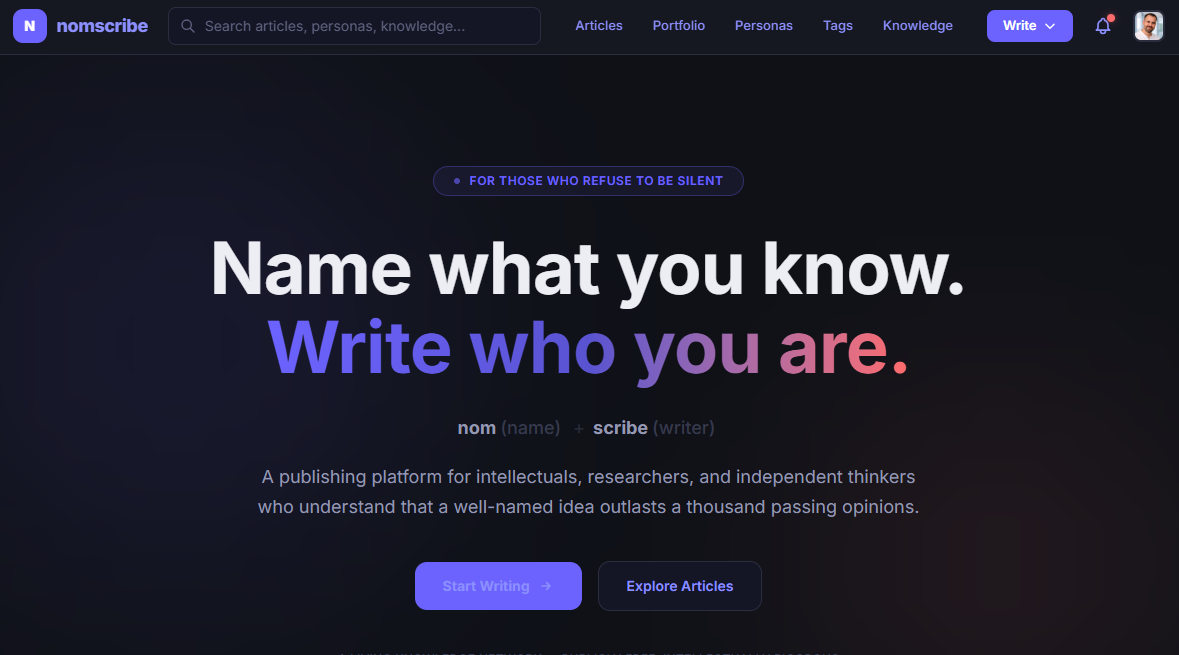
Nomscribe is an intellectual publishing platform where authors write and publish articles through distinct writing identities called personas. A single author can maintain multiple personas -- a programmer, a philosopher, an investor -- each with its own voice, color, and body of work.
But Nomscribe goes beyond blogging. Every article connects to structured knowledge entities: books, authors, quotes, topics, and historical events. These connections form a living knowledge graph that grows organically as authors publish and cross-reference ideas. Readers can trace a concept from an article to its cited book, then to every other article on the platform that references that same book.
The result is a hybrid of Medium's publishing experience, Notion's structured organization, and Reddit's community-driven discussion -- designed for people who think seriously and write across multiple intellectual domains.
Key capabilities include:
- Multi-persona publishing -- one author, many intellectual identities
- Rich article editor with TipTap (ProseMirror-based) and Markdown upload support
- Article series for multi-part deep dives
- Threaded comments with voting, bookmarks, and highlighted annotations
- A citation engine that links articles to books, authors, topics, events, and quotes
- Full-text search across all content and knowledge entities
- SEO-first architecture with server-side rendering, Open Graph tags, and JSON-LD structured data
2. Technology Stack
Nomscribe is built on a modern, performance-oriented stack chosen for type safety, scalability, and developer productivity.
Backend -- .NET 10 with Vertical Slice Architecture: The API layer uses ASP.NET Core Minimal APIs organized as vertical slices -- each endpoint is a self-contained static class with its own request/response DTOs, FluentValidation validator, and handler method. EF Core handles writes while Dapper handles reads, giving the best of both worlds: change tracking for mutations and raw SQL performance for queries. Authentication uses JWT (RS256) with OAuth 2.0 providers only (Google, GitHub, LinkedIn). Logging and observability run through Serilog and OpenTelemetry.
Frontend -- Angular 21 with Signals and SSR: The frontend uses Angular 21 with standalone components, NgRx SignalStore for state management, and Angular SSR for server-side rendering. All styling is done with Tailwind CSS -- no component-level stylesheets. The editor is powered by TipTap, storing content as ProseMirror JSON for editing fidelity and rendered HTML for reading and search indexing.
Database -- PostgreSQL 16+ via Supabase:
PostgreSQL handles all persistence, with full-text search powered by tsvector GIN indexes on article content. All tables use snake_case naming with an nscr_ prefix, UUID primary keys, and timestamptz timestamps. Supabase provides the managed hosting layer.
Testing: Backend tests use xUnit, FluentAssertions, and Testcontainers (spinning up real PostgreSQL instances). Frontend tests use Jasmine/Karma for unit tests and Playwright for end-to-end testing against the live Angular dev server.
3. Integrations
Nomscribe connects to external services and standards at several points:
OAuth 2.0 Authentication -- Google, GitHub, and LinkedIn are the sole authentication providers. There is no email/password registration. This simplifies security, eliminates password management, and meets users where they already have accounts.
Supabase (PostgreSQL hosting) -- The database runs on Supabase's managed PostgreSQL infrastructure, providing connection pooling, automated backups, and a dashboard for monitoring -- without running a local database container.
TipTap / ProseMirror Editor -- The rich-text editor integrates TipTap, a headless ProseMirror wrapper, enabling collaborative-grade editing with a structured document model. Content is stored in dual format: ProseMirror JSON (for lossless editor round-trips) and rendered HTML (for SSR, search indexing, and reading).
Markdown Import (remark) -- Authors can upload
.mdfiles that are parsed via remark and converted into ProseMirror JSON, allowing writers who prefer plaintext workflows to publish without friction.SEO Standards -- Every public page renders with Open Graph tags, Twitter Card meta tags, JSON-LD structured data (schema.org/Article, schema.org/Book, schema.org/Person, schema.org/Quotation), canonical URLs, and an auto-generated sitemap. Angular SSR ensures search engines see fully rendered content.
Social Sharing -- Articles can be shared via direct link, Twitter/X, LinkedIn, and copy-to-clipboard, with rich previews powered by the Open Graph integration.
Citation Engine -- A built-in reference system lets authors link articles to knowledge entities using
[[#tag]]syntax. An AI-assisted suggestion layer (planned for Phase 3) will analyze article text and propose entity links during editing, with the author always in control.
4. Why Nomscribe Matters
Most publishing platforms treat articles as isolated documents. A blog post on Medium has no structural relationship to the books it references or the ideas it builds upon. Nomscribe changes this by making knowledge connections a first-class feature.
For authors, the persona system solves a real identity problem. Engineers who also write about philosophy or investing are forced to either mix unrelated content under one profile or maintain separate accounts. Nomscribe lets one person publish across multiple intellectual identities while maintaining a unified portfolio.
For readers, the knowledge graph transforms passive reading into active exploration. Instead of finishing an article and moving on, a reader can follow a cited book to discover every other article on the platform that references it, find related quotes, or explore the author entity page to see their broader influence across the community's writing.
For the ecosystem, Nomscribe builds something that doesn't exist today: a user-generated knowledge network where every article enriches a shared graph of ideas, references, and discussions. Over time, this creates a living encyclopedia written by its users -- where ideas are traceable back to their sources and forward to the conversations they inspire.
The platform is SEO-first by design. Server-side rendering, structured data, and clean URL hierarchies (/@author/persona/article-slug) mean that Nomscribe content is discoverable through search engines from day one -- a critical differentiator for any publishing platform competing for organic growth.
5. Who Is Nomscribe For?
Authors and knowledge creators who think across multiple domains -- engineers who write about philosophy, researchers who also invest, writers who explore technology and culture. If you have more than one intellectual identity and want a single home for all of them, Nomscribe is built for you.
Researchers and academics who want their published work connected to a broader knowledge context. The citation engine and knowledge graph make it easy to link articles to books, authors, and topics, creating a web of references that grows with every publication.
Curious readers and students who want more than headlines and hot takes. Nomscribe's interconnected content model rewards deep reading: follow a quote to its source, trace an idea across multiple authors, or browse all articles tagged with a specific topic to build a comprehensive understanding.
Writing communities and intellectual circles looking for a platform that values substance over engagement metrics. Nomscribe's engagement model -- comments, annotations, backlinks -- is designed to reinforce the knowledge graph rather than drive vanity metrics. The persona directory enables community-level discovery: browse all "Philosopher" personas across the platform to find new voices within a specific intellectual domain.
Content strategists and thought leaders who need their writing to be discoverable. With SSR, Open Graph tags, JSON-LD structured data, and clean URL hierarchies, Nomscribe articles are optimized for search engine visibility and social sharing out of the box.
Comments
Sign in to leave a comment.
No comments yet. Be the first to share your thoughts!